
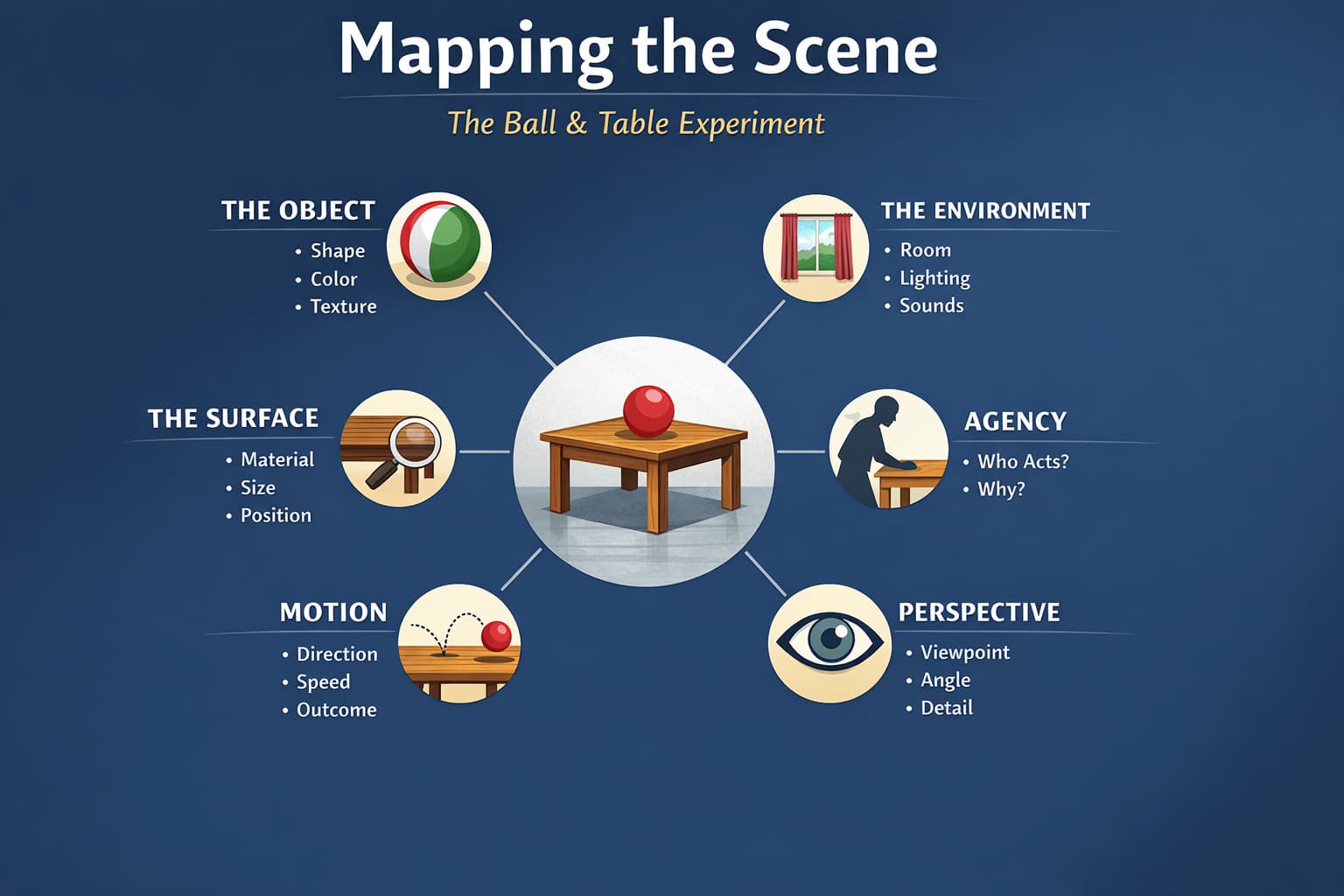
The Ball and Table Experiment
A tiny thought experiment that reveals surprising differences in how minds work
Imagine a room.
In the center of that room sits a table. On that table is a ball.
Now imagine the ball begins to move.
That’s the entire prompt.
When I ask people to describe what happens next, the responses are wildly different. Some people immediately describe colors, textures, and lighting. Others describe only the motion. Some introduce a person who caused the movement. A few strip the scene down to something almost mathematical: a sphere moving across a surface.
All from the same three sentences.
The Ball & Table exercise works because it provides just enough structure to start a mental scene while leaving most of the world undefined. What people choose to include—or leave out—can reveal interesting differences in how our minds naturally build situations.
But before you read further, there’s one important thing to know.
⚠️ Spoiler Warning
If you haven’t taken the Ball & Table exercise yet, you may want to try it first.
The analysis below explains some of the patterns people tend to show in their descriptions. Reading it beforehand may influence what details you notice when you imagine the scene.
If you’d rather peek anyway, that’s perfectly fine. Just know it may change your results a little.
Why This Simple Prompt Works
The exercise is intentionally vague.
You’re told there is a room, a table, and a ball. Then the ball begins to move.
Everything else is left open.
Your mind has to decide:
- What kind of ball is it?
- What kind of table?
- What does the room look like?
- What caused the movement?
- Is there a person involved?
- What happens next?
Some people naturally fill in these details. Others don’t.
Neither approach is right or wrong. They simply reflect different ways people mentally construct scenes.
When I started asking friends and family to try this exercise, certain patterns began to appear.
Five Common Scene-Building Styles
1. The Pure Vector (Level 1 – Aphantasia):
The Scene: “A ball on a table rolls.”
The Insight: Focus on Efficiency. No noise, no friction, just the data of the movement.
The Structuralist (Level 2):
The Scene: “A blue ball on a wooden table rolls to the edge.”
The Insight: Focus on Properties. The mind adds color and material but ignores the “Room.”
The Builder (Level 3 – The “Middle”):
The Scene: “A red ball on a glass table in a sunny room moves.”
The Insight: Focus on Atmosphere. The “Environment” coordinate is now online, but the “Agency” (the person) is still missing.
The Systemic Visionary (Level 4):
The Scene: “A neon ball on a marble table with floor-to-ceiling windows is nudged by a force.”
The Insight: Focus on Context. High-resolution environment, but the “Human Factor” is still a ghost or a nudge.
The Cinematic Influencer (Level 5 – Hyperphantasia)
The Scene: “An Amish woman in a blue dress rolls a red tennis ball on an Ikea table…”
The Insight: Focus on Agency. Full-spectrum rendering where the “Who” is as detailed as the “What.”
What the Exercise Is—and Isn’t
The Ball & Table exercise isn’t a personality test and it isn’t a diagnosis.
It’s simply a small way of noticing something we often overlook: people experience their inner worlds differently.
It’s important to understand that none of these are “better” than the others. A Level 1 is a high-speed processor; a Level 5 is a high-fidelity artist. Both are Warriors, just with different “GPUs.”
Many of us assume that other minds work the same way ours does. When someone imagines a scene, we assume they see roughly what we see.
Often, they don’t.
My Own Surprise: Aphantasia
I discovered this firsthand when I learned that I have something called aphantasia—the inability to see mental images.
When people say “picture a beach,” many of them literally see a beach in their mind. I don’t. My mind represents the idea of the beach conceptually rather than visually.
Learning that other people experience mental imagery so differently was a genuine shock. It made me realize how easy it is for our minds to assume that everyone else’s inner experience matches our own.
Exercises like the Ball & Table prompt can sometimes hint at these differences.
If you’re curious about how vivid your mental imagery is, psychologists often use something called the Vividness of Visual Imagery Questionnaire (VVIQ) to measure it more directly.
Why I Built This
The Ball & Table experiment is part of a larger project called Symdiy.
The goal isn’t to categorize people or place them into rigid boxes. It’s simply to create tools that help us notice how our minds work—and how they might differ from someone else’s.
Sometimes a tiny thought experiment can open a surprisingly large conversation.
Try It Yourself
If you haven’t tried the exercise yet, take a moment now.
Close your eyes.
Imagine a room.
In the center of the room is a table. On the table is a ball.
Now imagine the ball begins to move.
What happens next?
Whatever you noticed—or didn’t notice—is part of how your mind naturally builds the world.